
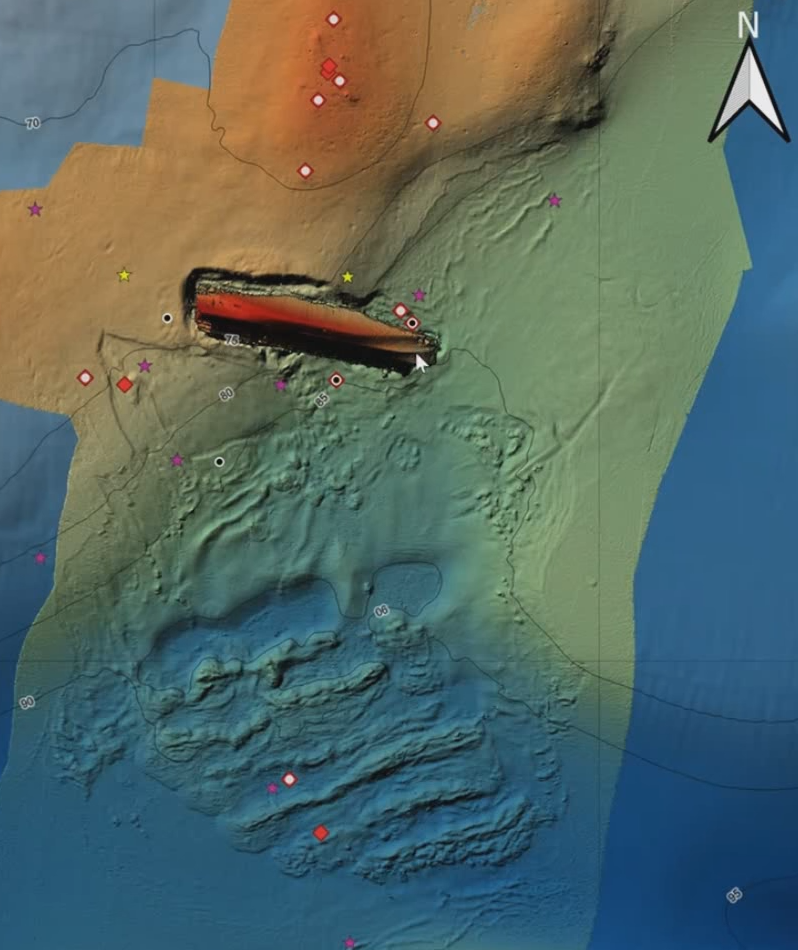
This spring and summer, a set of marine surveys is planned to be carried out at the shipwreck site of M/S Estonia, the main objective of which will be to examine, first and foremost, the wreck and the adjacent seafloor. Among these, the ferromagnetic survey will involve a geophysical survey where the primary focus will be on delineating magnetic anomalies but also on collecting information about seabed sediments in the area of the wreck of M/S Estonia and along the route of the ferry immediately before sinking. The photogrammetry and 3D laser scanning survey, meanwhile, will see the mapping of the entire wreck, including the car deck and its interior, as well as pinpointing structural damage. Other marine surveys that will be carried out include the measurement of currents and seawater turbidity. Based on the digital model of M/S Estonia, the investigators plan to create a variety of tabletop models and develop a so-called digital twin of the vessel for performing various simulations. All of the necessary public procurement procedures for the planned surveys have now been launched. In addition, in-depth interviews will be conducted, first, with surviving crew and passengers, second, with members of the relief crew, and, third, with shore and port personnel.
„The Estonian and Swedish states have decided in principle to each allocate 3 million euros for the investigation of the wreck of M/S Estonia, of which the Estonian Safety Investigation Bureau has, as of now, been granted 1.6 million euros for preliminary surveys,” said Rene Arikas. „The problem is that there are very few companies that are interested in participating in the marine surveys. One reason for this is that survey ships are already swamped with work in connection with other long-term and large-scale projects in the offshore oil, gas, and wind energy sectors. At the same time, the Estonian public procurement process is very complicated compared to that of Sweden, for example, and is targeted at Estonian-speaking providers. This greatly limits interest in the contracts. Furthermore, compared to one year ago, when we first started planning the surveys, the prices of many services have gone up several times over, with the price of a barrel of oil now also standing at over 100 dollars – all of which puts us in a difficult position for finding contractual partners.”
With respect to the interviews planned to be conducted with survivors of the shipwreck, Jüri Lember enquired whether, after such a long time, there is anything to ask from the persons affected to which the answers are not already known. Rene Arikas asserted that a thorough interview will be conducted with each survivor, giving them the chance to talk about everything related to the accident in a peaceful and neutral environment. “The interviews will be conducted in a way that lets the interviewee to feel safe and comfortable and to speak in their first language. Any information that is shared with representatives of the Safety Investigation Bureau will remain anonymous unless the interviewee wishes to reveal their name,” Arikas stated.
„In parallel with the preparation of the surveys and interviews, we are also working on examining all of the materials collected during past investigations,” Arikas said. „We have set ourselves the objective of ensuring that all national investigation materials related to the sinking of M/S Estonia are properly systematised, digitised, and backed up, in order to avoid the loss of any vital information. Written materials are held in the archives of a number of agencies, such as the Estonian Police and Border Guard Board and the Office of the Prosecutor General, but also in Finland and Sweden. Going through all of them to set up an adequate single archive is a highly time- and resource-intensive affair.”

