
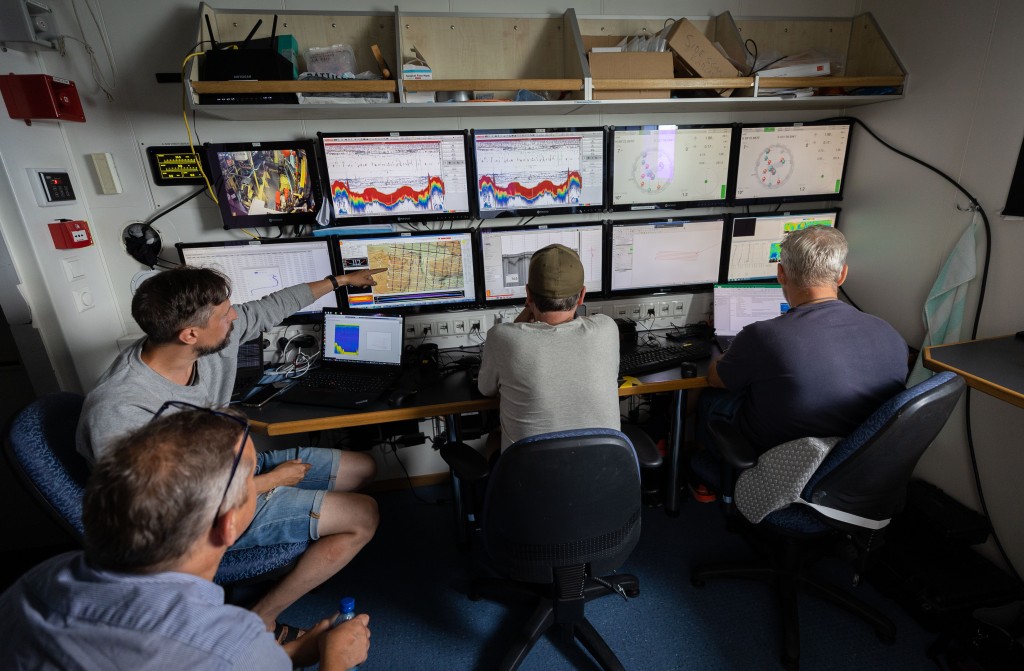
The first two days of the preliminary surveys of the wreck of MV Estonia have proven to be very productive. They included surveys of the shipwreck and the surrounding seafloor with a multibeam sonar, which provided an initial overview of the condition of the vessel.
“On Friday, 9 July, at 15:00, we managed to start the multibeam sonar surveys of the shipwreck on schedule, and to map the orientation of the vessel and the condition of the surrounding seafloor,” stated Rene Arikas, the director of the Estonian Safety Investigation Bureau. “The first survey took a long time to complete, and we did not finish the work until late in the evening, when it was getting dark outside and the operations began to be obstructed by rising winds and swells, which disrupted the activities of the Swedish research vessel Electra af Askö. Despite the swell, the quality of the data as well as the imaging quality obtained with the multibeam sonar is surprisingly good. The survey mothership EVA-316 then spent the night at anchor at the Port of Lehtma, while Electra af Askö moored at the Port of Hanko in Finland. During the night, we processed the data obtained from the multibeam sonar survey, and in the morning we were able to return to the MV Estonia shipwreck site.”
According to Rene Arikas, the image obtained using the multibeam sonar clearly shows the bow, keel, and stern of the wreck of the sunken ferry. You can see the bridge, the superstructure, rows of windows on the upper decks, as well as the anchor, propeller, and other details. Additionally, deformations are visible in the center part of the hull.
“In the area surrounding the wreck to the north of the vessel, the image shows a ridge, which is thought to have formed as a result of the sinking of the vessel,” Arikas explained. “Between this ridge and the hull, there is a mostly 5- to 7-metre-wide trench that extends up to 10 meters in places. Another trench has formed at the stern of the vessel. These trenches have probably formed due to the vessel having slid downwards towards the south and east from its original position, as it lies on a ridge of unstable clay. There are signs of a total of four minor and major sliding incidents, the last of which occurred during the burying of the wreck in 1995–1996, when the entire bow and stern section as well as the southern section of the vessel were covered with geotextile, which was then secured with steel wire rope, covered with a layer of rock, and finally buried under nearly 300,000 cubic meters of sand. Obviously, the burying of the wreck was unsuccessful and led to the sliding incidents evident in the sonar surveys today.”
On Saturday, 10 July, the entirety of the site was surveyed using a seafloor profiler. According to Rene Arikas, the image obtained shows a cross-section of the center part of the wreck of MV Estonia. “Based on this, we can say that the center part of the vessel is resting on a harder moraine deposit, which has stopped the vessel from moving, while the bow and stern sections are resting on a softer clay deposit. The surveys showed that the center part of the vessel is slightly higher and there is some deflection. These are likely to be deformations, which we are planning to investigate in more detail in the next few days.”
Today, on 11 July, the team was joined by Mesotech 3D scanning expert Brian Abbott from the United States. The team tested equipment and prepared precise coordinates for the deployment of the Mesotech sonar system. The tripod-mounted 3D scanner is planned to be dropped in 20–25 different locations around the wreck to obtain high-precision survey data on the damage suffered by the hull as well as the seafloor in the immediate vicinity of the sunken vessel.
“After the 3D scanner survey, we will quickly carry out an initial processing of the data, based on which we will decide how to proceed with the surveys. If there is sufficient water transparency, we intend to deploy an ROV in the coming days in order to study previously identified hull deformations – in the stern, center, and starboard sections – in more detail and to record their exact location,” Arikas said. “We are measuring the transparency of the seawater around the wreck regularly.”

